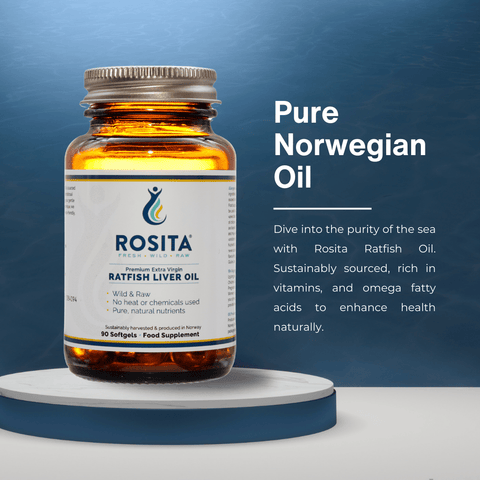
Rosita has released its raw ratfish liver oil in softgel form. The same oil as in the 10 ml and 50 ml bottles — now without the dropper, without measuring, and without the taste. Here's the story of the fish, the oil, and what makes it worth paying attention to.

What is ratfish, actually?
Ratfish — Chimaera monstrosa in Latin — is a deep-water cartilaginous fish that lives at depths of 300 to 500 metres in the North Atlantic. Despite the name, it's not a rat; it belongs to the chimaera family, an ancient lineage that split from sharks and rays several hundred million years ago. In English they're also known as ghost sharks, and Rosita sometimes calls this product their "ancient oil" for that reason.
The fish has an unusual anatomy: its liver makes up more than 60 % of its total body mass. That's why it yields oil at all — a typical fish liver sits closer to 10 % of body weight. Rosita's ratfish is sustainably caught in the pristine Norwegian fjords, and the livers are processed in small batches.
What are alkylglycerols, and why care?
Alkylglycerols — also called ether lipids — are a group of fatty acids with a slightly unusual molecular structure: an ether bond instead of an ester bond. They occur naturally in small amounts in human breast milk, bone marrow and a few marine sources. Ratfish liver oil is one of the most concentrated natural sources available.
Each three-softgel serving of Rosita's product provides 208 mg of alkylglycerols. For comparison: a regular cod liver oil contains trace amounts, but nothing meaningful. That's why the ratfish oil sits alongside cod liver oil in Rosita's lineup rather than replacing it.

Omega-3 and naturally occurring vitamins
Beyond the alkylglycerols, each three-softgel serving provides:
- 52 mg of marine omega-3 triglycerides (of which 11 mg DHA and 10.6 mg EPA)
- Naturally occurring vitamin A and vitamin D3
- No artificial additives — no colours, flavours or preservatives
Worth noting: the omega-3 dose is lower than in a standard cod liver oil. Ratfish oil is not primarily an EPA/DHA source — it's an alkylglycerol source. Many people take it alongside a regular cod liver oil to cover both.
The Rosita Method — raw, cold-processed, no heat or chemicals
Most fish oils on the market are produced using heat and chemical solvents to separate the oil from the fish tissue, then concentrate it. The result is a capsule with a high EPA/DHA dose — but also an oil whose structure has been rewritten during production.
The Rosita Method is different. The oil is extracted without heat, without chemicals, and without mechanical pressure. The liver is processed gently so the oil comes out in its original form, with the fatty acid chains and the fat-soluble vitamins intact in the proportions found in the raw material. The oil is produced at Ecomarine A/S in Norway; encapsulation and packaging happen in the United Kingdom.
Because the oil is raw, it's sensitive to heat and light — hence the amber glass bottles and the storage guidance below.

How to use it — "Low and Slow"
Rosita's own recommendation is three softgels per day (250 mg of oil per capsule, 750 mg total). But they emphasise starting cautiously:
"Rosita is premium, pure, and potent. Therefore, it's critically important to start slowly, with a lower dosage. For example, 1 softgel every other day, until you can determine how the oil affects your body and what dosage feels right for you."
For anyone with a sensitive gut, new to liver oils, or carrying metabolic load, this is sound advice. Build up to three softgels per day after 1–2 weeks if the lower dose feels fine.
Who is it for?
- You already take Rosita cod liver oil and want to add ratfish for the alkylglycerols
- You've used the liquid ratfish oil before but prefer capsules for taste or travel
- You're looking for a premium wholefood source of alkylglycerols
- You respond well to fat-soluble vitamins from whole liver oils rather than isolated additions
Less suitable if you're primarily after high EPA/DHA doses — a regular cod liver oil or a distilled fish oil is more cost-effective per gram of omega-3.
Who should take care?
Pregnant or breastfeeding women, children, people with known fish allergies, and anyone on blood-thinning medication should consult a doctor before use. High doses of omega-3 can potentiate the effects of warfarin, apixaban, rivaroxaban and similar medications.
Storage and shelf life
Unopened, Rosita Ratfish Softgels keep for three years from the production date. Store in a dark place at room temperature (ideally 15–25 °C / 58–78 °F). Do not refrigerate or freeze the softgels — prolonged cold increases the permeability of the gel and can shorten shelf life. Short temperature exposure either way has little impact.
Independently tested
Rosita has its oils independently tested. For the ratfish oil, the Institute of Aquaculture at the University of Stirling conducts the analyses — one of Europe's leading centres for marine research. Testing covers heavy metals, oxidation levels and fatty-acid profiles.
Frequently asked questions
Does ratfish oil taste fishy?
The softgel form means you taste nothing at all. That's one advantage over the liquid oil, which has a distinctly fishy character — a sign that it's intact and not deodorised.
Can I combine it with Rosita's cod liver oil?
Yes, many people do. The two oils complement each other: cod liver provides more omega-3 and vitamin A/D; ratfish provides alkylglycerols. Keep total marine oil under 3–5 g per day unless you have specific guidance.
Why can't I store it cold?
The soft gelatin capsule becomes more porous at low temperatures over time. That can accelerate oxidation of the oil inside. For liquid cod liver oil, refrigeration is still right — this rule is specific to softgels.
How long before I notice an effect?
Fatty acids take time to integrate into cell membranes. Allow 4–8 weeks of consistent use before judging anything.
Is ratfish fishing sustainable?
Rosita works with fishermen using selective catch methods in Norwegian fjords. Ratfish is not red-listed in Norway, but it isn't a high-volume species either — production is intentionally limited.
Is it allergen-friendly?
The product is gluten-, soy- and dairy-free. The softgel does contain fish gelatin (not bovine), so it's not suitable for vegetarians.
Shop at Naturshopen
Rosita Extra Virgin Ratfish Liver Oil Softgels – 90 capsules →
References
- GBC Wellness — official product sell sheet for Rosita Ratfish Liver Oil Softgels.
- Rosita Real Foods — product documentation and the Rosita Method.
- EFSA — authorised health claims for EPA, DHA and vitamin A/D.
- Institute of Aquaculture, University of Stirling — third-party analyses.