In the inbox this week: a newsletter from Kyoto Obubu Tea Farms, a small tea producer in the village of Wazuka south of Kyoto. It's one of the newsletters we always open — an insider view from people who actually work the tea bushes every day. This is what we took away this month, and how it lands in our own matcha thinking.
Wazuka — Japan's quietly working tea heart
Wazuka is a small agricultural community in Kyoto Prefecture, about 40 minutes south of Kyoto city. It isn't highlighted by tourist guides in the way Uji is — but about 40 % of what gets sold as Uji matcha is actually grown there. High-elevation hills, cool nights, mist that lingers until lunchtime: the same microclimate that makes Uji matcha what it is.
Obubu Tea Farms has been there for several generations, running a combination of tradition and openness. They host international interns, hold hand-rolling workshops with the village's old masters, and publish monthly newsletters that read more like a diary than marketing. That's where this week's story comes from.
Autumn harvest — the quieter sister
Most tea drinkers know the spring harvest — shincha, the first tea leaves, celebrated annually in Japan as a seasonal high point. But the Japanese tea year has a second harvest season in autumn: akibancha (秋番茶) and tencha (材茶), harvested from September to November.
The autumn harvest accounts for a significantly larger volume but is positioned less as a premium product. These are the leaves that often become everyday tea — bancha, hojicha, matcha intended for cooking rather than ceremonial whisking. That functional role is the reason it exists.
Spring vs autumn leaves — a small discovery
One detail from Obubu's newsletter that caught our attention: spring leaves and autumn leaves look different, and it's down to plant biology.
In spring, the tea bush's new shoots are fine, delicate, and full of nutrients accumulated during winter dormancy. When these leaves are rolled, the cell walls break down and release the leaf's rich water content — which allows the processors to shape narrow, tight sencha needles with precision.
In autumn, the bushes have been growing through the hot Japanese summer. The leaves are larger, with slightly lower water content. When they're rolled, the material doesn't break down in the same way — and the resulting shape is flatter, less spiralled.
That's why a good sencha looks like fine pine-needle buds, while a bancha looks more like flat elongated leaves. Different seasons, different leaves, different cultural roles.
The Japanese tea family — more than just matcha
Matcha gets most of the attention in the West, but it's one in a broader family:
- Sencha — the most common green tea in Japan, brewed from whole leaves (not ground). Fresh, grassy, umami.
- Gyokuro — premium sencha where the bushes are shaded in the final weeks before harvest. More umami, less bitterness.
- Matcha — tencha leaves ground into powder. The whole leaf is consumed, not just the infusion.
- Bancha — everyday tea from larger leaves later in the season. Milder, lower caffeine.
- Hojicha — roasted bancha. Nutty, bread-like flavour and almost no caffeine — popular in the evening.
- Genmaicha — bancha blended with roasted rice. Nutty, home-cooking in character.
Hojicha is the perfect autumn drink. The roasting removes much of the green sencha brightness and leaves a warm, almost caramelised base note. Obubu recommends an iced hojicha latte as a late-autumn transition drink — warm, creamy, toasted flavours that still work cold.
Simple iced hojicha latte
Measure 1 teaspoon of hojicha powder into a cup. Whisk it into a splash of hot water (about 60 ml) to form a smooth slurry. Add cold milk (or oat milk) and top up with ice. Sweeten to taste with a touch of honey or maple syrup. That's it.
How we think when selecting matcha
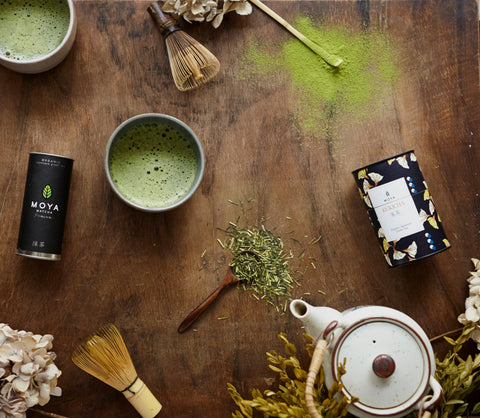
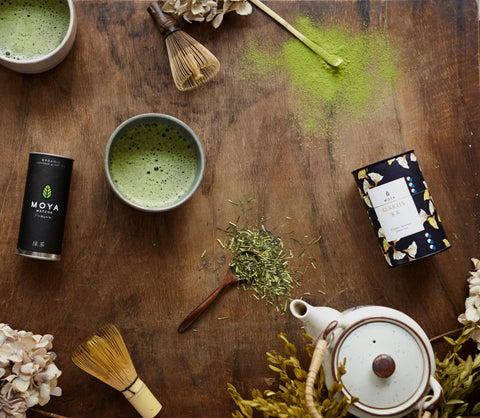
Our matcha range at Naturshopen is built around Moya Matcha — a Polish-Japanese brand that works directly with small farms in Uji and Nishio. We chose Moya because:
- Traceable origin — every batch code on the tin can be followed back to the producer
- Genuine ceremonial grade where it's ceremonial grade, and honestly labelled as culinary (cooking matcha) when it is — no label drift
- Ceramic tins like chawan — heavier but make a real functional difference for flavour and storage
- Tested for heavy metals — Japanese matcha is generally safe but worth verifying
We also carry matcha accessories: chasen (whisk), chashaku (scoop), matcha bowl. Making matcha "properly" doesn't require a full tea ceremony kit, but a good whisk makes a real difference to creaminess.
Something to try
If you've never tried Japanese green tea beyond matcha — start with a small pouch of sencha or a hojicha. Bancha and genmaicha are extremely affordable everyday options that still hold their quality when they come from the right producer. We don't yet stock all the varieties, but the range is growing gradually — let us know if there's a specific Japanese tea you're looking for.
See our matcha range → · Matcha accessories (whisk, scoop, bowl) →
In closing
This is why we gladly read newsletters from small producers — more than any trend report, they tell you how something actually gets made, season by season. Obubu's newsletter is open to anyone interested in Japanese tea; we're happy to link to them.
Warm regards,
Carl & Anna, Naturshopen.se
Facts about spring/autumn tea leaves, the akibancha harvest and the iced hojicha recipe are based on the newsletter from Kyoto Obubu Tea Farms, October 2026.